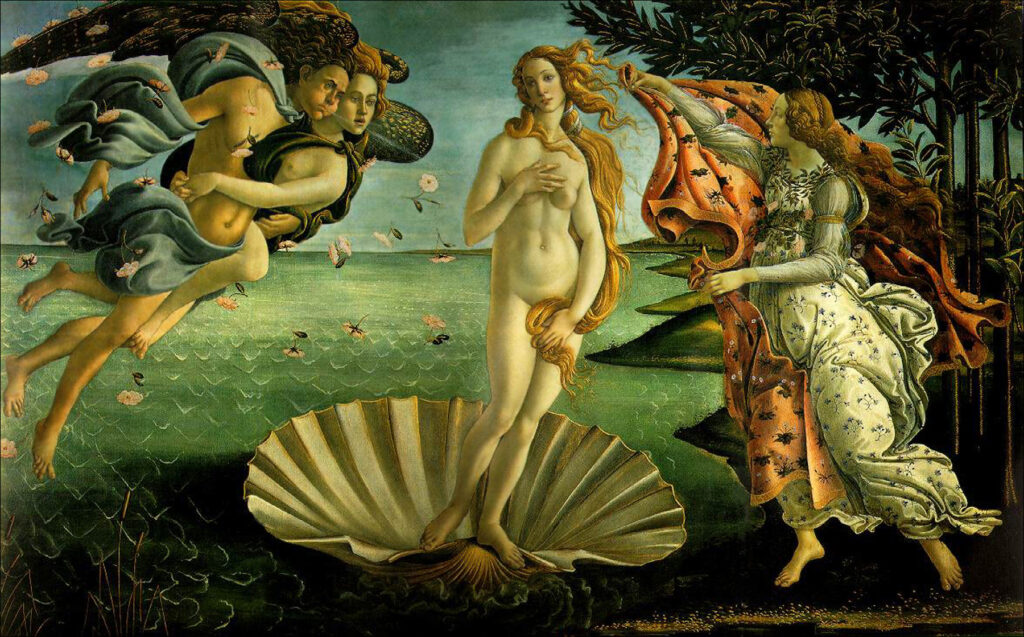
Aphrodite the goddess of love, beauty and fertility, was revered in Phoenician legends from at least 3200 BC. She was distinguished from the leading goddess in the remainder of the Near East, and later in Greece, primarily because those others wore armor and fought in battle. The other goddesses included the Greek Athena (in full armor in the Parthenon), and the Canaanite Astarte.
Aphrodite’s nature reflected the peaceful Phoenician society in which she developed. She was at the heart of their community, even when other deities later joined her. The people there referred to her simply as “Our Lady.” She had an intimate relationship with Adonis near Byblos in Lebanon.
The sea-going Phoenicians brought Aphrodite with them to islands across the Mediterranean such as Cythera, and then to Cyprus. This genesis was documented in the ancient legends and myths told about her. When classical Greece arose and Cyprus became that society’s valued source of copper, the legend of beautiful Aphrodite came to mainland Greece.
Birth of Aphrodite
This is the most famous description of her birth. It occurred following a dispute between Uranus — father of the gods — and his son Chronos, who castrated him.
The genitals, cut off with adamant
And thrown from land into the stormy sea,
Were carried for a long time on the waves.
White foam surrounded the immortal flesh,
And in it grew a girl. At first [she] touched
On holy Cythera, from there [she] came
To Cyprus, circled by the waves. And there
The goddess came forth, lovely, much revered,
And grass grew up beneath her delicate feet.
Her name is Aphrodite among men
And gods, because she grew up in the foam. . . .
Hesiod, Theogony 185-195
After her arrival at Cyprus, Aphrodite appeared in many of the Greek epics and legends. Later she also appeared in the epics of the Romans, who called her Venus. She was always the beautiful goddess of love.
The content of this website is drawn from the research of historian Sanford Holst

Updated April 24, 2025
CLOUD: Aphrodite legend, Aphrodite myth, mythology, Cyprus

Further information
If you would like to experience more of the Phoenician world than you find in these short articles, see the book Phoenicians: Lebanon’s Epic Heritage. This extensive exploration is brightened with 104 illustrations.
Going beyond the few traditionally-cited facts, this authoritative work draws from discussions with leading archaeologists and historians to discover new clues and lines of inquiry into this secretive society.
Phoenicians
You can take a look inside this book. See the first pages here.
