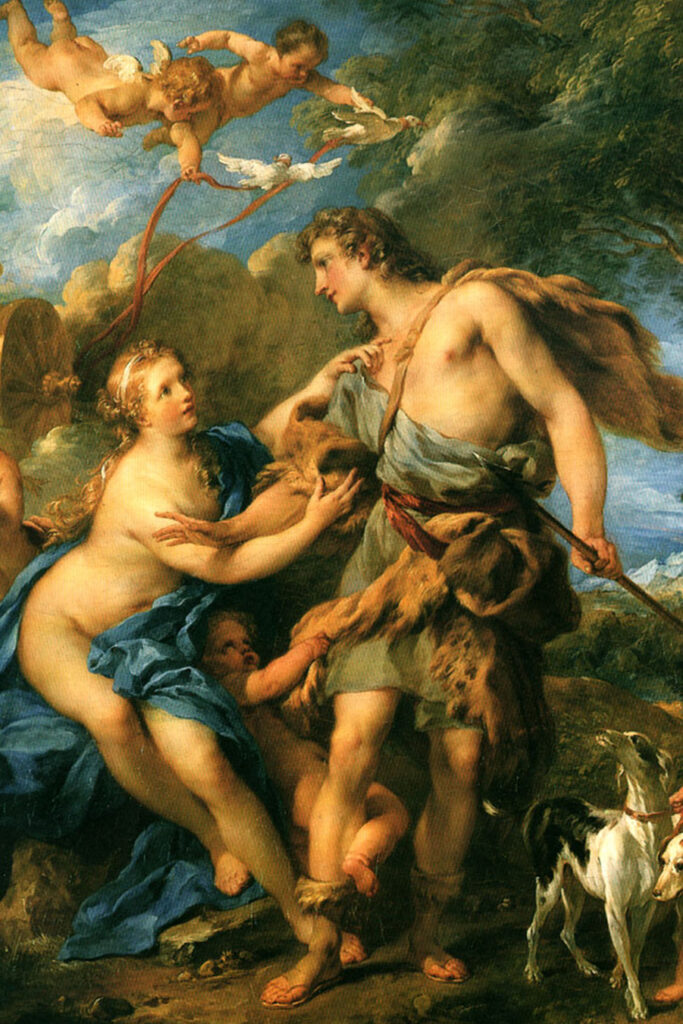
At Byblos in Lebanon a beautiful baby boy was born and left without parents to care for him. According to legend, he was beloved by goddesses and became known as ‘adon, which meant “lord,” and then as Adonis.
Our Lady Aphrodite fell in love with him, and placed him in the care of the goddess of the underworld for safekeeping. Unfortunately when she went back to claim the boy, the other woman had also fallen in love with him and would not give him up. As a compromise it was agreed the boy would live half of the year with each of them. Nurtured by the love of these two women, he grew into a handsome and influential young man in the hills above Byblos.
Tragically, one of the male gods became jealous of Adonis. The rival changed himself into a wild boar and fatally gored the handsome young man. As Adonis lay dying in the arms of Aphrodite, drops of his blood spilled out and stained the anemone flower crimson red. When he was gone, Aphrodite went to the goddess of the underworld again to see if their bargain could be restored. Her outpouring of grief and love was so strong that it was agreed Adonis would live again. He would stay in the hills of Byblos for six months each year during spring and summer, and then return below for fall and winter.
In observance of these things, the river which coursed down from these hills to a place near Byblos was called the Adonis River (today, Nahr Ibrahim). Each year when runoff from the Lebanon Mountains turned the river red, it was said to be the blood of Adonis. The crimson-red anemone continued to bloom there each year. And the grotto at Afqa on the side of the mountain from which the Adonis River flowed became a place of pilgrimage.
In his honor “Adonis gardens” were grown by sprouting seeds in a dish which sprang up bright and green, but then perished. This was done every year in memory of his life and death. At the same time, a period of mourning was declared during which women would wail and expose their breasts in an expression of grief. After seven days of mourning, Adonis was reborn amid effusive celebration and festivities.
The Greeks later became so caught up in these emotional observances that the legend of Adonis was brought completely into their mythology as well.
The content of this website is drawn from the research of historian Sanford Holst

Updated April 24, 2025
CLOUD: Adonis legend, Adonis myth, mythology, Lebanon

Further information
If you would like to experience more of the Phoenician world than you find in these short articles, see the book Phoenicians: Lebanon’s Epic Heritage. This extensive exploration is brightened with 104 illustrations.
Going beyond the few traditionally-cited facts, this authoritative work draws from discussions with leading archaeologists and historians to discover new clues and lines of inquiry into this secretive society.
Phoenicians
You can take a look inside this book. See the first pages here.
